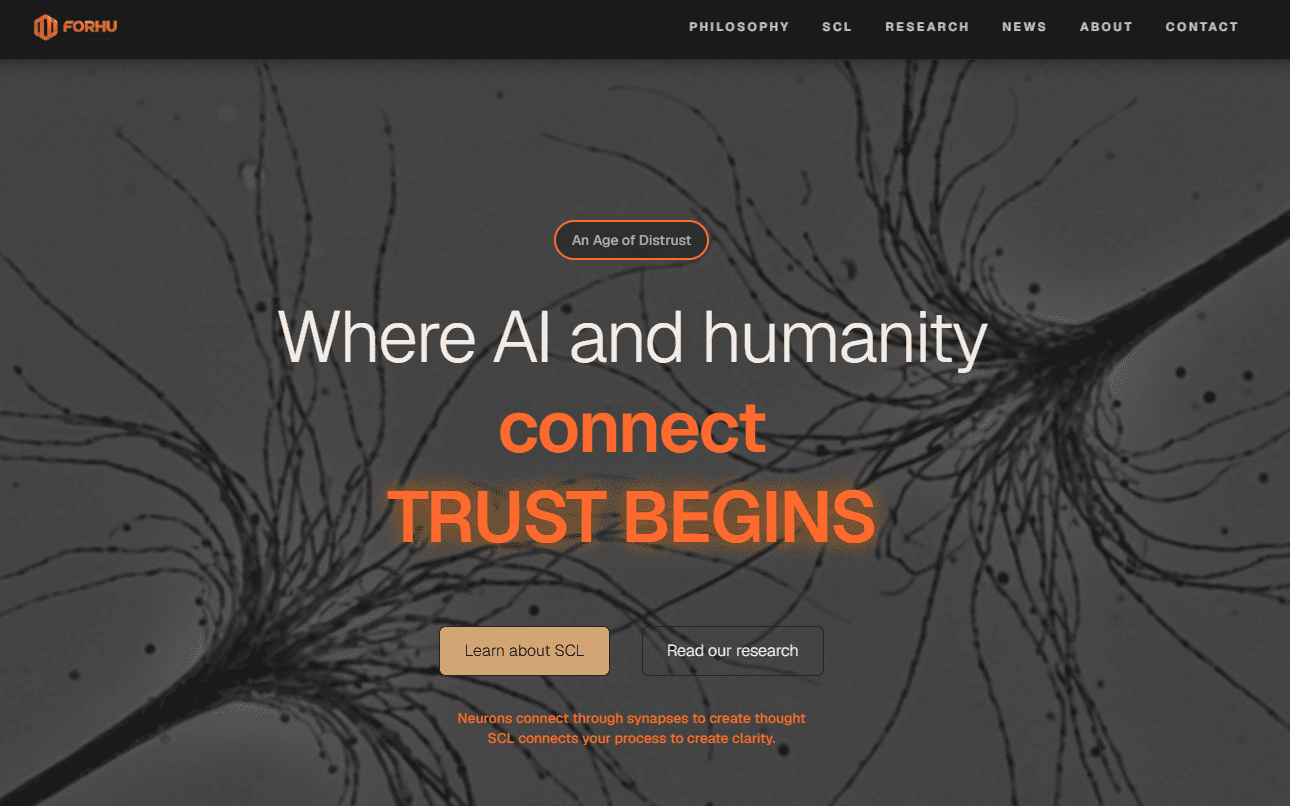
TechnologyForhu Aims to Unlock AI Transparency for Enhanced Trust
The rapid evolution of artificial intelligence is creating a paradoxical situation: while AI systems grow increasingly sophisticated, their internal logic becomes harder to decipher. This obscurity poses challenges for businesses, regulatory agencies,…
By MAGAZINE TECHY·September 10, 2026·3 min
The rapid evolution of artificial intelligence is creating a paradoxical situation: while AI systems grow increasingly sophisticated, their internal logic becomes harder to decipher. This obscurity poses challenges for businesses, regulatory agencies, and consumers who find themselves expected to trust the functionality of these advanced AI models, even as their decision-making processes remain largely hidden. The implications of these technologies are significant, affecting billions of dollars in investments and impacting crucial human decisions, thereby raising the stakes dramatically. In response to these complexities, Forhu has emerged to confront this issue directly.
Founded under the guiding principle of "For Human," Forhu operates as a cutting-edge technology firm dedicated to researching and developing AI technologies that not only augment human capabilities but also safeguard human dignity. Rather than resorting to transient fixes like trial-and-error or continuous prompt adjustments, Forhu introduces a transformative concept in the industry via its Structured Cognitive Loop (SCL).
Central to the company’s philosophy is a commitment to transparency, which it elevates above traditional performance measurements. In an industry often obsessed with attaining high benchmarks and maximizing token generation, Forhu insists that even superior performance loses its merit if the outcomes it produces remain unexplained. Building and sustaining trust is crucial, especially in high-pressure business environments, where an absence of trust can render even highly functional solutions potentially dangerous. Consequently, Forhu has outlined a series of non-negotiable principles that guide its operations:
First is the principle of "Transparency Must Be a Given." Forhu asserts that any aimed deployment of an AI system should be able to articulate its reasoning processes clearly. It underscores that the methodology behind outputs is as significant as the outputs themselves.
The second principle, “Learning from Errors,” maintains that any discrepancies or mistakes should not be overlooked but instead documented and leveraged as critical information, thereby enhancing the system’s memory and overall control processes to mitigate the risks of similar issues recurring in the future.
Adhering to the third principle, “Design Over Deployment,” Forhu emphasizes that trust cannot simply be added after a flawed model is released. Rather, an effective model must incorporate accountability and governance from its very foundation.
The principle of "Upholding Human Dignity" mandates a strict adherence to ethical requirements as foundational constraints, ensuring that these ethical standards are embedded within the architecture of AI systems to maintain integrity against any adversarial attempts or prompts.
In stark contrast to the traditional generative AI models that primarily rely on predictive pattern recognition, Forhu is innovating with a fundamentally sound framework that combines core AI designs with insights from cognitive science and formal epistemology. This systematic approach involves rigorous verification processes, assessments of memory, and strict controls to transform obscure predictions into transparent reasoning that can be audited effectively.
As artificial intelligence technology weaves deeper into the fabric of societal frameworks, Forhu is pioneering the shift from the conventional "black box" model of AI towards a more transparent, accountable, and human-centered approach they refer to as the "Glassbox." This shift represents a significant movement towards not only accepting AI technology but also comprehending its inner workings, heralding a new era of understanding and trustworthiness in AI.